Java Static Keyword - Variables, Methods, Blocks and Nested Classes
⏱️ 8 min read • Beginner Level • Lesson 47
The static keyword in Java is used to create class-level members. A static member belongs to the class, not to a specific object.
Before learning static, you should understand
Java class and objects,
Java class members, and
Java constructors.
What is static in Java?
In Java, static is a non-access modifier. It is used with variables,
methods, blocks, and nested classes.
A static member belongs to the class. That means it can be accessed using the class name without creating an object.
- Static members are not specific to individual objects.
- Static variables are shared by all objects.
- Static methods can be called using the class name.
- Static blocks execute once when the class is loaded.
- Static nested classes are nested classes declared with
static.
Types of Static Members in Java
A Java class can have the following static members:
| Static Member | Meaning |
|---|---|
| Static Variable | A class-level variable shared by all objects. |
| Static Method | A class-level method that can be called without creating an object. |
| Static Block | A block that runs once when the class is loaded. |
| Static Nested Class | A nested class declared using the static keyword. |
Static Variable in Java
A variable declared with the static keyword is called a
static variable. It is also called a class variable.
- Static variable belongs to the class.
- Only one copy of a static variable is created per class.
- All objects share the same static variable.
- It is useful for common properties shared by all objects.
schoolName can be static because all students may belong
to the same school.
Static Variable Example
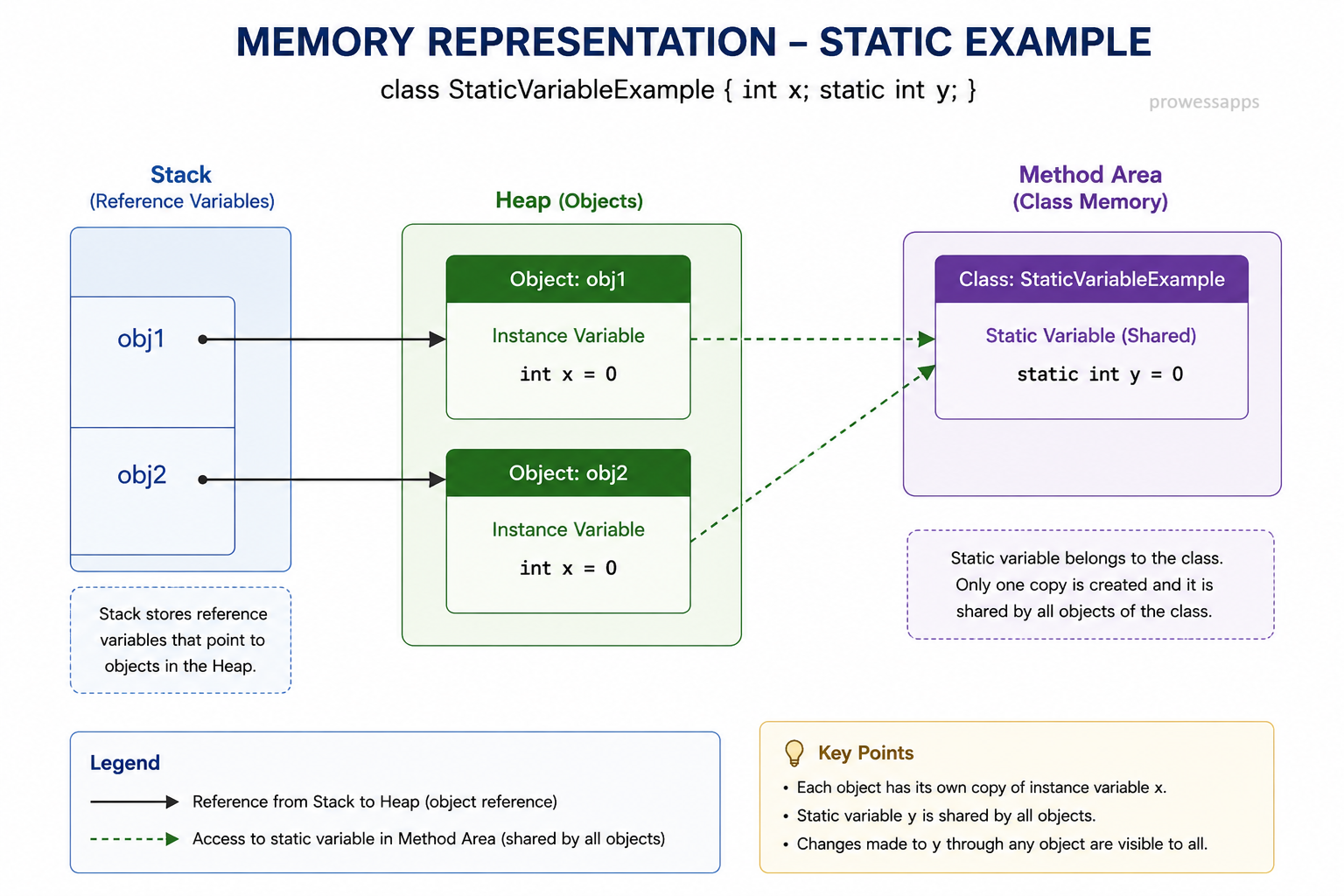
In this example, x is an instance variable, so every object gets its own copy.
But y is static, so it is shared by all objects.
class StaticVariableExample {
    int x;
    static int y;

    void counter() {
        x++;
        y++;

        System.out.println("x: " + x);
        System.out.println("y: " + y);
    }

    public static void main(String[] args) {
        StaticVariableExample obj1 = new StaticVariableExample();
        obj1.counter();

        StaticVariableExample obj2 = new StaticVariableExample();
        obj2.counter();
    }
}
Output:
x: 1
y: 1
x: 1
y: 2
Explanation
xis an instance variable, so each object has its own copy.yis static, so it is shared by all objects.- When
obj1.counter()runs,xbecomes 1 andybecomes 1. - When
obj2.counter()runs, its ownxbecomes 1, but sharedybecomes 2.
Static Method in Java
A method declared with the static keyword is called a
static method. It belongs to the class and can be called using the class name.
- A static method can directly access static variables and static methods.
- A static method cannot directly access non-static variables or non-static methods.
- An object is required to access non-static members inside a static method.
thisandsupercannot be used inside a static method.- A static method cannot be declared as abstract.
Static Method Example
class StaticMethodExample {
    int x = 10;
    static int y = 20;

    static void show() {
        System.out.println("Static method called");
        System.out.println("y: " + y);

        StaticMethodExample obj = new StaticMethodExample();
        System.out.println("x: " + obj.x);
    }

    public static void main(String[] args) {
        StaticMethodExample.show();

        // Static method can also be called directly inside same class
        show();
    }
}
Output:
Static method called
y: 20
x: 10
Static method called
y: 20
x: 10
- Static variables are initialized.
- Static blocks execute.
- Main method executes.
StaticMethodExample.show().
Calling static methods using objects is allowed but not recommended.
Static Block in Java
A static block, also called a static initializer block, is used to initialize static data. It executes automatically when the class is loaded.
- Static block executes before the
main()method. - Static block executes only once.
- It is commonly used for static initialization.
class StaticBlockExample {
    static {
        System.out.println("Static block executed");
    }

    public static void main(String[] args) {
        System.out.println("Main method executed");
    }
}
Output:
Static block executed
Main method executed
Static Nested Class in Java
A class declared inside another class with the static keyword is called
a static nested class.
A static nested class can access static members of the outer class directly. To access non-static members, it needs an object of the outer class.
class Outer {
    static String message = "Hello from static member";

    static class Nested {
        void show() {
            System.out.println(message);
        }
    }

    public static void main(String[] args) {
        Outer.Nested obj = new Outer.Nested();
        obj.show();
    }
}
Output:
Hello from static member
static final Variable in Java
A variable declared with static final is usually used to create constants.
It belongs to the class and its value cannot be changed after initialization.
class Circle {
    static final double PI = 3.14159;

    public static void main(String[] args) {
        System.out.println("PI: " + Circle.PI);
    }
}
Output:
PI: 3.14159
Static Members vs Instance Members
| Static Members | Instance Members |
|---|---|
| Belong to the class. | Belong to objects. |
| Shared by all objects. | Each object has its own copy. |
| Can be accessed using class name. | Accessed using object reference. |
| Loaded when class is loaded. | Created when object is created. |
When Should We Use static?
- When data should be shared by all objects.
- For utility methods that do not depend on object state.
- For constants using
static final. - For common counters, configurations, and application-wide settings.
Can we override a static method in Java?
Answer: No. Static methods belong to the class, not to objects. A static method in a child class hides the parent method instead of overriding it.
Common Mistakes with static
- Trying to access non-static members directly from a static method.
- Using
thisorsuperinside a static method. - Calling static methods using object reference instead of class name.
- Thinking each object has a separate copy of static variables.
- Overusing static members and making code less object-oriented.
- The
statickeyword creates class-level members. - Static variables are shared by all objects of the class.
- Static methods can be called using the class name.
- Static methods can directly access only static members.
- Static blocks execute once when the class is loaded.
- Static nested classes can access static members of the outer class directly.
static finalis commonly used for constants.
Frequently Asked Questions
🧠 Test your understanding with a quick quiz
🚀 Quick Knowledge Check
Topic: Static-keyword | Language: Java
🎉 Great job! Continue learning Java OOP step by step.