OOP Concepts in Java - Object, Class and Four Pillars
⏱️ 8 min read • Beginner Level • Lesson 43
Completed on . You can revise this lesson or continue to the next topic.
Object-Oriented Programming, commonly called OOP,
is a programming style where we solve problems by creating objects.
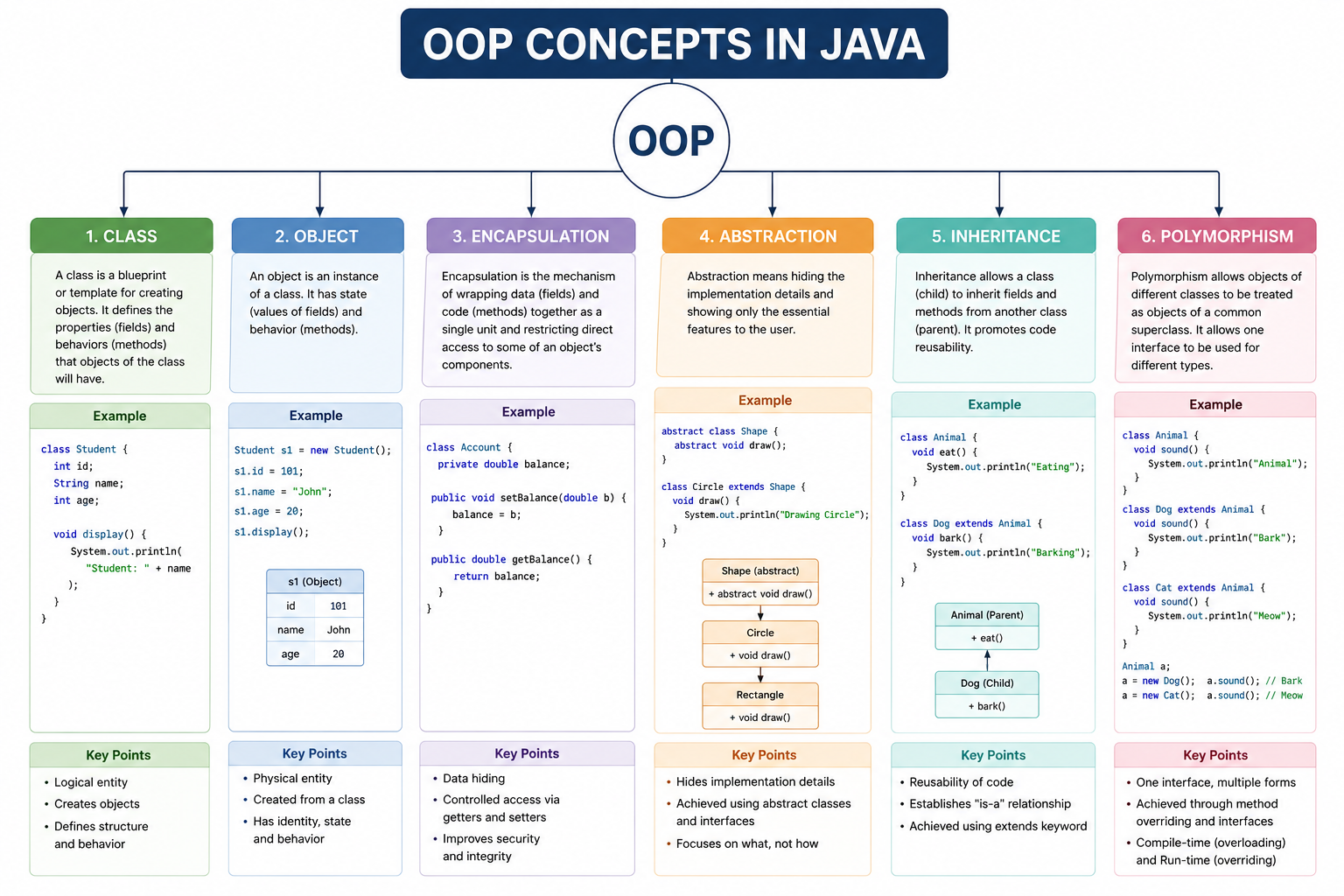
Java is strongly based on OOP concepts such as class, object,
encapsulation, abstraction, inheritance, and
polymorphism.
Before learning OOP concepts, you should understand Java variables, Java methods, and Java data types.
What is OOP in Java?
OOP stands for Object-Oriented Programming. It is a programming approach where a program is designed using objects. An object combines data and behavior into a single unit.
-
Java supports object-oriented programming.
-
OOP helps organize code using classes and objects.
-
It makes code reusable, secure, flexible, and easier to maintain.
Why use OOP?
Think of a real-world school system. A student has data such as name, roll number, and marks. A student also has actions such as study, attend exam, and show result. In OOP, we can represent this real-world student as an object.
- Representing real-world entities in code.
- Reusing code through inheritance.
- Protecting data using encapsulation.
- Hiding complex details using abstraction.
- Writing flexible code using polymorphism.
Real-World Example of OOP
Consider a banking application.
- Class: BankAccount
- Objects: JohnAccount, SarahAccount
- Encapsulation: Balance is protected.
- Abstraction: Users only see deposit and withdraw options.
- Inheritance: SavingsAccount inherits BankAccount.
- Polymorphism: Different accounts calculate interest differently.
OOP vs Procedural Programming
| Procedural Programming | Object-Oriented Programming |
|---|---|
| Focuses on functions | Focuses on objects |
| Less secure | More secure through encapsulation |
| Less reusable | Highly reusable |
| Difficult for large projects | Suitable for large applications |
Object in Java
An object is a real-world entity that has state and behavior.
For example, a laptop can be treated as an object:
| State / Data | Behavior / Action |
|---|---|
| Brand, RAM, Storage, Color | Start, Shutdown, Run Program |
Class in Java
A class is a blueprint or template used to create objects. It defines what data and methods an object will have.
For example, Student can be a class, and Ayan,
Sarah, and John can be objects of that class.
Class and Object Example in Java
The following example creates a Student class and uses it to create an object.
class Student {
    String name;
    int rollNumber;

    void displayDetails() {
        System.out.println("Name: " + name);
        System.out.println("Roll Number: " + rollNumber);
    }
}

public class StudentExample {
    public static void main(String[] args) {
        Student s1 = new Student();

        s1.name = "Ayan";
        s1.rollNumber = 101;

        s1.displayDetails();
    }
}
Output:
Name: Ayan
Roll Number: 101
Explanation
Studentis a class.nameandrollNumberare data members.displayDetails()is a method.s1is an object of theStudentclass.- The object stores data and calls the method to display details.
Four Pillars of OOP in Java
Java OOP is mainly based on four important concepts:
1. Encapsulation
Wrapping data and methods together and protecting data from direct access.
2. Abstraction
Hiding internal details and showing only essential features.
3. Inheritance
Acquiring properties and methods of one class into another class.
4. Polymorphism
Performing one action in different ways.
Encapsulation in Java
Encapsulation means binding data and methods together inside a class. It also helps protect data by restricting direct access from outside the class.
A common way to achieve encapsulation in Java is by using private variables
and public getter/setter methods.
private
and providing controlled access through getter and setter methods.
Abstraction in Java
Abstraction means hiding implementation details and showing only important information to the user.
For example, when you drive a car, you use the steering wheel, accelerator, and brake. You do not need to know the internal engine working every time you drive.
abstract classes and interfaces.
Inheritance in Java
Inheritance allows one class to acquire the properties and methods of another class. It supports code reusability.
For example, Dog can inherit common properties from an Animal class.
extends keyword.
It helps in code reuse and creating parent-child relationships between classes.
Polymorphism in Java
Polymorphism means many forms. In Java, it allows one action to behave differently depending on the object or situation.
method overloading
and method overriding.
In the upcoming lessons, you will learn each OOP concept separately: Class and Object → Encapsulation → Inheritance → Polymorphism → Abstraction.
OOP Concepts Summary Table
| Concept | Meaning | Real-Life Example |
|---|---|---|
| Object | Entity with state and behavior | Student, Laptop, Car |
| Class | Blueprint for creating objects | Student class for many student objects |
| Encapsulation | Wrapping data and methods together | Bank account with private balance |
| Abstraction | Hiding internal details | Using ATM without knowing internal process |
| Inheritance | One class acquiring features of another | Dog inherits from Animal |
| Polymorphism | One action with many forms | Different animals make different sounds |
What are the four pillars of OOP?
Encapsulation, Abstraction, Inheritance, and Polymorphism.
- OOP stands for Object-Oriented Programming.
- Java supports OOP using classes and objects.
- An object has state and behavior.
- A class is a blueprint for creating objects.
- The four main pillars of OOP are encapsulation, abstraction, inheritance, and polymorphism.
- OOP helps make programs reusable, secure, flexible, and easier to maintain.
Interview Questions ⭐
🧠 Test your understanding with a quick quiz
🚀 Quick Knowledge Check
Topic: Oops-overview | Language: Java
Q1. What will be the output of this code?
class Student {
    String name = "Ayan";

    void display() {
        System.out.println(name);
    }
}

public class Test {
    public static void main(String[] args) {
        Student s1 = new Student();
        s1.display();
    }
}Q2. What is encapsulation in Java?
Q3. What is abstraction in Java?
Q4. What does OOP stand for in Java?
Q5. What is a class in Java?
Q6. Which statement is TRUE about class and object?
Q7. What is inheritance in Java?
Q8. What does polymorphism mean in Java?
Q9. Which of the following best describes an object in Java?
Q10. Which of the following are the four main pillars of OOP in Java?
🎉 Great job! Continue learning Java OOP step by step.
Have you completed this lesson?
Mark this lesson as completed to track your learning progress. To keep track across devices, please login and save your learning progress.

Discussion
Ask questions, share suggestions, or discuss this lesson.