History of Java - From Oak to Modern Java
⏱️ 6 min read • Beginner Level • Lesson 3
Java has an interesting history. It started as a project for digital devices, became known as Oak, and later evolved into one of the most popular programming languages in the world.
Before reading this lesson, you can review Java Introduction. After this lesson, continue with JDK, JRE and JVM.
Java History at a Glance
Why Was Java Created?
During the early 1990s, software was highly dependent on specific hardware and operating systems. Sun Microsystems wanted a language that could run on different devices without modification.
- Platform independence
- Portability
- Security
- Support for embedded devices
Origin of Java
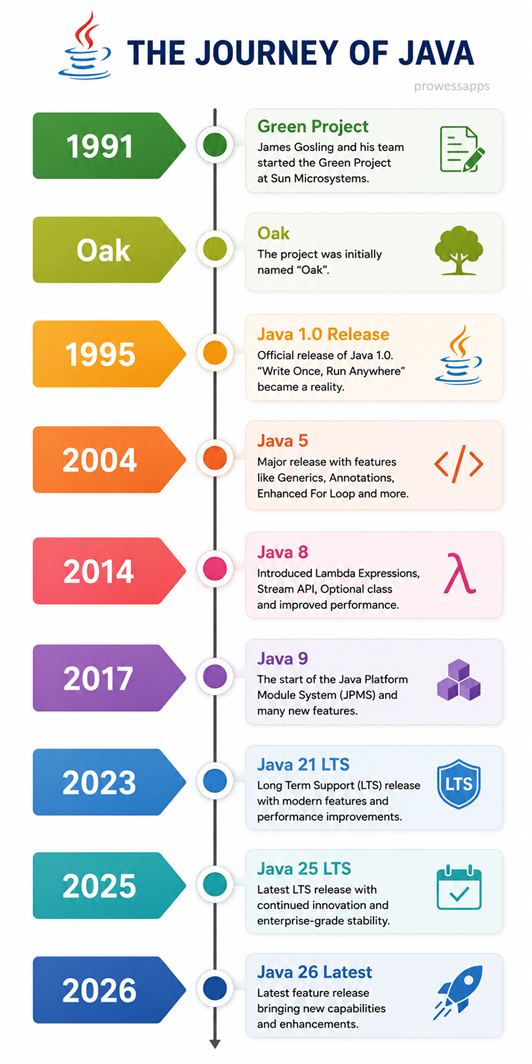
Java was developed by James Gosling and his team at Sun Microsystems. The goal was to create a programming language that could run on different types of devices without depending on a specific hardware platform.
The Green Project
The early development of Java started as part of the Green Project. The idea was to build software for interactive devices such as set-top boxes, televisions, and small digital devices.
Why Java was first called Oak
Java was initially called Oak. The name Oak was chosen because an oak tree was visible near James Gosling's office. Later, the name had to be changed because Oak was already being used by another company.
Why Oak became Java
After the name Oak could not be used, the language was renamed Java. The name Java was inspired by Java coffee, and it became the official name of the language.
Java Public Release
Java gained popularity after its public release in the mid-1990s. It became famous because of its platform independence and ability to run programs through the Java Virtual Machine.
Write Once, Run Anywhere
One of the biggest reasons behind Java's success was the idea of Write Once, Run Anywhere. Java code is compiled into bytecode, and bytecode can run on any system that has a JVM.
Java Source Code → Java Bytecode → JVM → Any PlatformJava Timeline
| Year | Important Event |
|---|---|
| 1991 | Java project started at Sun Microsystems. |
| 1995 | Java was publicly released. |
| 2009 | Oracle acquired Sun Microsystems. |
| Today | Java is widely used in backend, Android, enterprise, cloud, and banking systems. |
Java Version Evolution
| Version | Major Feature |
|---|---|
| Java 1.0 (1995) | First public release |
| Java 5 (2004) | Generics, Enhanced For Loop, Annotations |
| Java 8 (2014) | Lambda Expressions, Stream API |
| Java 9 (2017) | Module System |
| Java 17 (2021) | Long Term Support (LTS) |
| Java 21 (2023) | Latest LTS Release |
Java Today
Today, Java is one of the most widely used programming languages in the world. It is used for enterprise applications, Android development, cloud computing, banking systems, financial applications, and large-scale backend services.
History of Java at a Glance
| Topic | Details |
|---|---|
| Developer | James Gosling and team |
| Company | Sun Microsystems |
| Original Name | Oak |
| Started | 1991 |
| Released | 1995 |
| Famous Concept | Write Once, Run Anywhere (WORA) |
Did You Know?
- Java was originally called Oak.
- Java was developed by James Gosling and his team at Sun Microsystems.
- The first public version of Java was released in 1995.
- Java follows the principle of Write Once, Run Anywhere (WORA).
- Millions of applications worldwide still run on Java.
- Java was developed by James Gosling and his team at Sun Microsystems.
- Java started as part of the Green Project.
- Java was first named Oak.
- Oak was later renamed Java.
- Java became popular because of platform independence and WORA.
Frequently Asked Questions
🧠 Test your understanding with a quick quiz
🚀 Quick Knowledge Check
Topic: History | Language: Java
Q1. When was Java publicly released?
Q2. Which company acquired Sun Microsystems?
Q3. What was the Green Project related to?
Q4. Which concept helped Java become widely popular?
Q5. What was the original name of Java?
Q6. Why was Oak renamed to Java?
Q7. Who is known as the father of Java?
Q8. In which year did Java development begin?
Q9. What does WORA mean?
Q10. Java was developed at which company?
🎉 Great job! Continue learning Java step by step.