Java Class and Object - Object Creation, Reference and Examples
⏱️ 9 min read • Beginner Level • Lesson 44
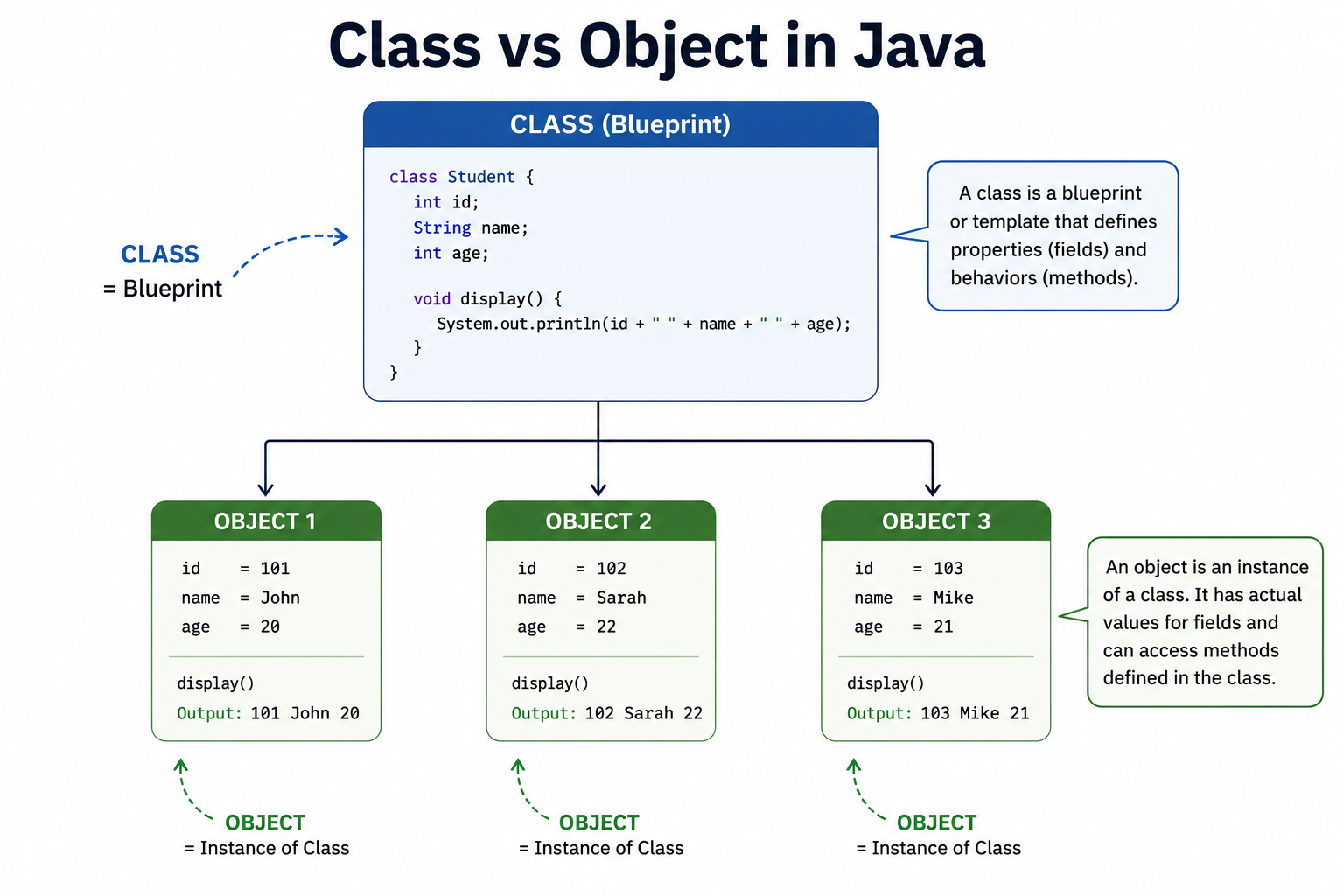
In Java, a class is a blueprint used to create objects, and an object is a real instance of a class. Classes define data and behavior, while objects use that data and behavior in a program.
Before learning class and objects, you should understand Java OOP concepts, Java methods, and Java variables.
What is Class in Java?
A class in Java is a template or blueprint that defines the properties (data) and behaviors (methods) of objects.
- A class is used to create objects.
- Class properties are called fields, attributes, or data members.
- Class behaviors are defined using methods.
- Fields and methods together are called class members.
- A class is declared using the
classkeyword.
Student class is like a template or blueprint. Every student object created from it can have its own name, roll number, and marks.
Syntax of Class in Java
class ClassName {
    // fields
    // methods
}
Here, ClassName should be a valid Java identifier. The class body can contain
fields, methods, constructors, blocks, and nested classes.
Example: Class with Fields and Method
class Test {
    int a;
    private int b;
    protected int c;
    public int d;

    void show() {
        System.out.println("show");
    }
}
What is Object in Java?
An object is an entity that has state, behavior, and identity.
| Characteristic | Meaning | Example |
|---|---|---|
| State | Data or values of an object | id, name, salary |
| Behavior | Actions performed by an object | showDetails(), deposit(), walk() |
| Identity | Unique identification of an object | JVM identifies each object uniquely |
Object Creation in Java
Creating an object from a class is known as object instantiation.
It is done using the new keyword.
ClassName objectName = new ClassName();ClassName objectName = new ClassName();
-
ClassNameis the class type of the reference variable. -
objectNameis the reference variable that stores the object's reference. -
newcreates a new object and allocates memory for it in the heap. -
ClassName()is the constructor call that initializes the object. -
The reference to the newly created object is assigned to
objectName.
What Happens During Object Creation?
- JVM allocates memory for the object in the heap.
- Instance variables receive default values.
- Constructor is executed.
- Reference is returned and stored in a variable.
A mobile phone company may have a Mobile class.
Samsung Galaxy, iPhone, and OnePlus devices are objects created from that class.
Each object has its own color, storage, and price.
Example: Object Creation and Member Access
This program creates an Employee object and accesses its fields and method.
class Employee {
    int id;
    String name;

    void showDetails() {
        System.out.println(id);
        System.out.println(name);
    }

    public static void main(String[] args) {
        Employee e = new Employee();

        e.id = 123;
        e.name = "Ayan Khan";

        e.showDetails();
    }
}
Output:
123
Ayan Khan
Explanation
Employeeis a class.idandnameare instance variables.showDetails()is an instance method.Employee e = new Employee();creates an object.- The object
eaccesses fields and method using dot.operator.
main() Method in Another Class
In real application development, every class does not need to have a main() method.
We can create one class and use it from another class.
class Employee {
    int id;
    String name;

    void showDetails() {
        System.out.println(id);
        System.out.println(name);
    }
}

public class MainClass {
    public static void main(String[] args) {
        Employee e = new Employee();

        e.id = 123;
        e.name = "Ayan Khan";

        e.showDetails();
    }
}
Output:
123
Ayan Khan
MainClass because it contains the main() method.
Object Memory Representation
In Java, the reference variable is stored in stack memory, while the actual object is stored in heap memory.
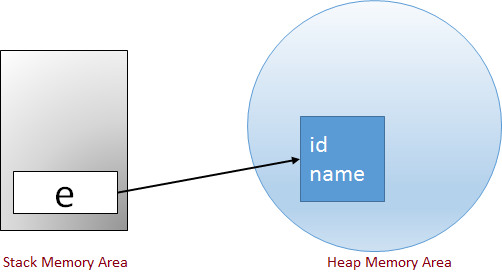
- Reference variable stores the address/reference of the object.
- The object is created in heap memory.
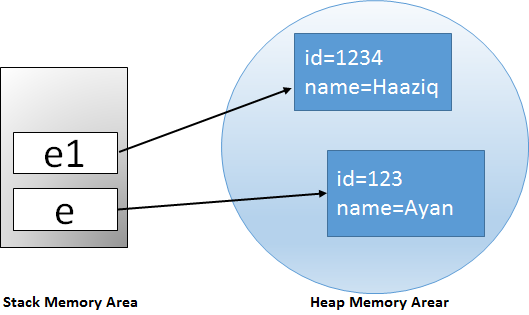
- Each object has its own copy of instance variables.
Instance Variable vs Reference Variable
| Instance Variable | Reference Variable |
|---|---|
| Stored inside object | Stores object reference |
| Created in Heap | Stored in Stack |
| Each object gets separate copy | Can point to same object |
Example: Multiple Objects of Same Class
We can create multiple objects of the same class. Each object has its own copy of instance variables.
class Employee {
    int id;
    String name;

    void showDetails() {
        System.out.println(id);
        System.out.println(name);
    }

    public static void main(String[] args) {
        Employee e1 = new Employee();
        Employee e2 = new Employee();

        e1.id = 123;
        e1.name = "Ayan";

        e2.id = 1234;
        e2.name = "Haaziq";

        e1.showDetails();
        e2.showDetails();
    }
}
Output:
123
Ayan
1234
Haaziq
Object Alias in Java
An object alias means another reference variable points to the same object. In this case, both references access the same object in heap memory.
class Employee {
    int id;

    public static void main(String[] args) {
        Employee e1 = new Employee();
        e1.id = 101;

        Employee e2 = e1; // alias

        e2.id = 202;

        System.out.println(e1.id);
        System.out.println(e2.id);
    }
}
Output:
202
202
Both e1 and e2 refer to the same Employee object in heap memory. No new object is created. So, any change made through one reference is reflected through the other.
Anonymous Object in Java
An object without a reference variable is called an anonymous object. It is usually used when an object is needed only once.
class Employee {
    void showDetails() {
        System.out.println("Employee details displayed");
    }

    public static void main(String[] args) {
        new Employee().showDetails();
    }
}
Output:
Employee details displayed
Difference Between Class and Object
| Class | Object |
|---|---|
| Class is a blueprint or template. | Object is an instance of a class. |
| No memory is allocated for instance fields when only class is defined. | Memory is allocated when object is created using new. |
| Defines fields and methods. | Uses fields and methods. |
Example: Employee class. |
Example: Employee e = new Employee(); |
Common Mistakes
- Thinking class and object are the same.
- Using object members without creating an object.
- Forgetting that each object has its own copy of instance variables.
- Confusing reference variables with actual objects.
- Using object alias without understanding shared object behavior.
Interview Questions
What is the difference between a class and an object?
A class is a blueprint, while an object is an instance of a class.
Where are objects stored in Java?
Objects are stored in Heap memory.
Where are reference variables stored?
Reference variables are stored in Stack memory.
- A class is a blueprint used to create objects.
- An object is an instance of a class.
- Class members include fields and methods.
- The
newkeyword creates objects at runtime. - Reference variables are stored in stack memory, while objects are stored in heap memory.
- Multiple objects have separate copies of instance variables.
- Object alias means two reference variables point to the same object.
- Anonymous objects are objects without a reference variable.
Now that you understand classes and objects, learn about class members, constructors, methods, and access modifiers.
Frequently Asked Questions
🧠 Test your understanding with a quick quiz
🚀 Quick Knowledge Check
Topic: Class-and-objects | Language: Java
Q1. What are fields and methods collectively called in a class?
Q2. Where is an object stored in Java memory?
Q3. What will be the output of this code?
class Employee {
    int id;

    public static void main(String[] args) {
        Employee e1 = new Employee();
        e1.id = 101;

        Employee e2 = e1;
        e2.id = 202;

        System.out.println(e1.id);
        System.out.println(e2.id);
    }
}Q4. What is a class in Java?
Q5. What will be the output of this code?
class Employee {
    int id;
    String name;

    void showDetails() {
        System.out.println(id);
        System.out.println(name);
    }

    public static void main(String[] args) {
        Employee e = new Employee();
        e.id = 123;
        e.name = "Ayan Khan";
        e.showDetails();
    }
}Q6. What is an object alias in Java?
Q7. What is an anonymous object in Java?
Q8. What is an object in Java?
Q9. Which of the following is the correct syntax to create an object of Employee class?
Q10. Which keyword is used to create an object in Java?
🎉 Great job! Continue learning Java OOP step by step.