Java Recursion - Recursive Methods with Complete Examples
⏱️ 9 min read • Beginner Level • Lesson 36
Recursion in Java is a programming technique where a method calls itself to solve a problem. A recursive method keeps calling itself until a stopping condition is reached.
Before learning recursion, you should understand Java Methods, Java Method Parameters, and Java Method Overloading.
- What is recursion?
- How recursion works
- Base case and recursive case
- Simple recursion example
- Factorial using recursion
- Sum of natural numbers
- Fibonacci series using recursion
- Print numbers in reverse
- Stack overflow in recursion
- Iteration vs recursion
- When to use recursion
- Complete example
- Common mistakes
- Summary
What is Recursion in Java?
Recursion is a technique where a method solves a problem by calling itself again with a smaller or simpler input. This continues until the problem reaches a condition where no more recursive call is needed.
returnType methodName(parameters) {
    if (baseCondition) {
        return value;
    }

    return methodName(smallerInput);
}
Real-World Examples of Recursion
Recursion is commonly used when a problem can be divided into smaller versions of the same problem.
- Calculating factorials
- Generating Fibonacci numbers
- Traversing folders and files
- Tree and graph processing
- Backtracking algorithms
- Directory searching systems
How Recursion Works in Java
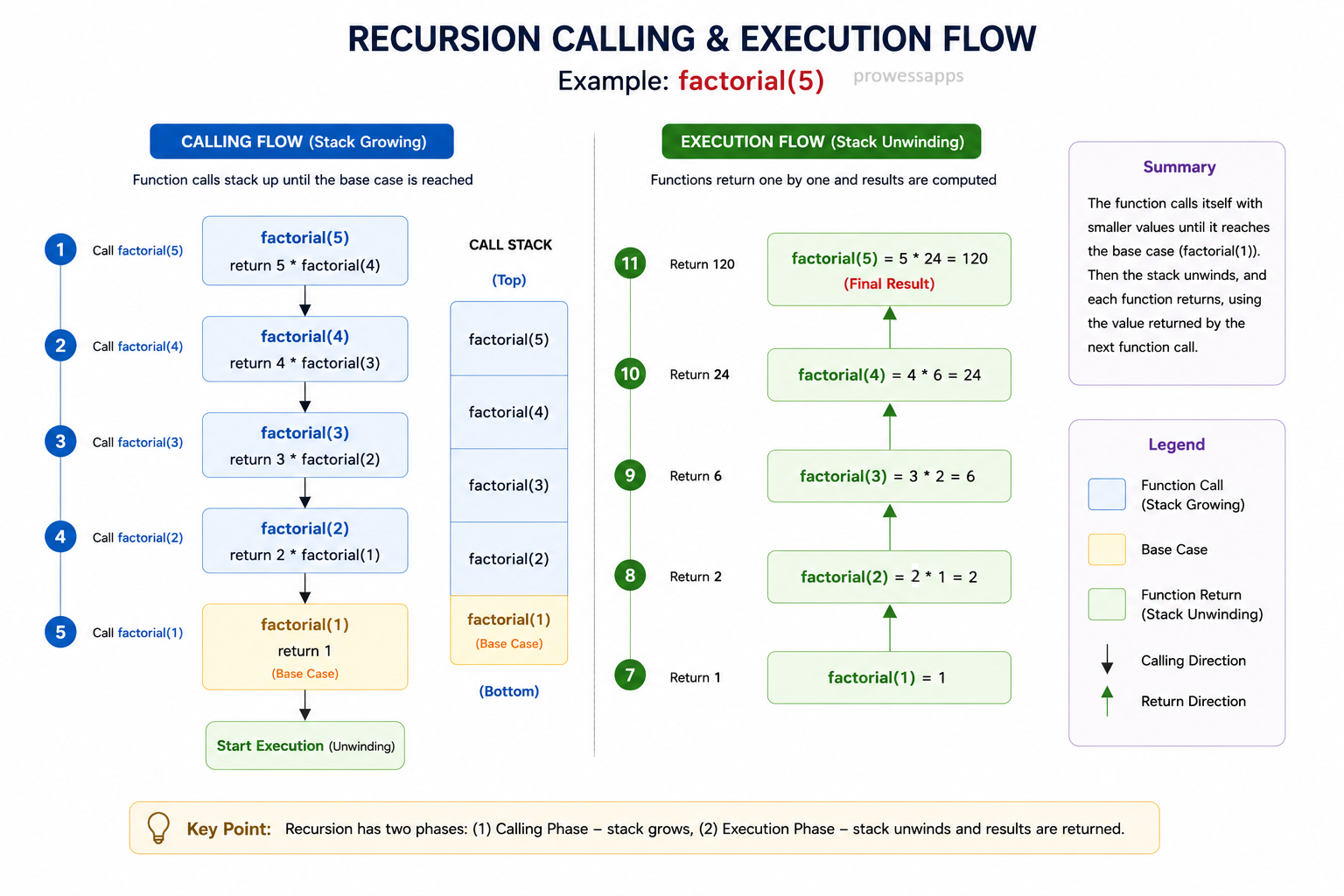
Every recursive call is stored in memory as a separate method call. Java uses the call stack to keep track of these method calls. When the base condition is reached, the methods start returning back one by one.
- The method is called with an input value.
- The method checks the base condition.
- If the base condition is false, the method calls itself with a smaller input.
- This process continues until the base condition becomes true.
- After that, all pending method calls return one by one.
Base Case and Recursive Case
A recursive method usually has two important parts: base case and recursive case.
| Part | Meaning |
|---|---|
| Base Case | The stopping condition that prevents infinite recursion. |
| Recursive Case | The part where the method calls itself with a smaller or simpler input. |
StackOverflowError.
Simple Recursion Example
In this example, the method prints numbers from 1 to 5 using recursion.
public class SimpleRecursionExample {
    static void printNumbers(int number) {
        if (number > 5) {
            return;
        }

        System.out.println(number);
        printNumbers(number + 1);
    }

    public static void main(String[] args) {
        printNumbers(1);
    }
}
Output:
1
2
3
4
5
Code Explanation
printNumbers(1)starts the recursive process.- The condition
number > 5is the base case. - If the number is not greater than 5, it is printed.
printNumbers(number + 1)calls the same method with the next number.- When number becomes 6, the method returns and recursion stops.
Factorial using Recursion in Java
Factorial of a number means multiplying that number by all positive numbers below it.
For example, 5! = 5 × 4 × 3 × 2 × 1 = 120.
public class FactorialRecursion {
    static int factorial(int number) {
        if (number <= 1) {
            return 1;
        }

        return number * factorial(number - 1);
    }

    public static void main(String[] args) {
        System.out.println("Factorial: " + factorial(5));
    }
}
Output:
Factorial: 120
Code Explanation
factorial(5)is called from themain()method.- The base case is
number == 1. When number becomes 1, the method returns 1. - The recursive case is
number * factorial(number - 1). - The calls become
5 * factorial(4), then4 * factorial(3), and so on. - Finally, Java calculates
5 * 4 * 3 * 2 * 1, which gives120.
Sum of Natural Numbers using Recursion
We can use recursion to calculate the sum of natural numbers up to a given number.
For example, sum up to 5 is 5 + 4 + 3 + 2 + 1 = 15.
public class SumNaturalNumbers {
    static int sum(int number) {
        if (number == 0) {
            return 0;
        }

        return number + sum(number - 1);
    }

    public static void main(String[] args) {
        System.out.println("Sum: " + sum(5));
    }
}
Output:
Sum: 15
Code Explanation
sum(5)starts the recursive calculation.- The base case is
number == 0, which returns 0. - The recursive case is
number + sum(number - 1). - The calculation becomes
5 + 4 + 3 + 2 + 1 + 0. - The final result is
15.
Fibonacci Series using Recursion
In the Fibonacci series, each number is the sum of the previous two numbers. The series starts with 0 and 1.
public class FibonacciRecursion {
    static int fibonacci(int number) {
        if (number == 0) {
            return 0;
        }

        if (number == 1) {
            return 1;
        }

        return fibonacci(number - 1) + fibonacci(number - 2);
    }

    public static void main(String[] args) {
        for (int i = 0; i < 7; i++) {
            System.out.print(fibonacci(i) + " ");
        }
    }
}
Output:
0 1 1 2 3 5 8
Code Explanation
- The method
fibonacci()returns the Fibonacci number at a given position. - The base cases are
number == 0andnumber == 1. - For other numbers, the method returns
fibonacci(number - 1) + fibonacci(number - 2). - The loop calls
fibonacci(i)for values from 0 to 6. - The output displays the first seven Fibonacci numbers.
Print Numbers in Reverse using Recursion
Recursion can also be used to print numbers in reverse order.
public class ReverseNumbersRecursion {
    static void printReverse(int number) {
        if (number == 0) {
            return;
        }

        System.out.println(number);
        printReverse(number - 1);
    }

    public static void main(String[] args) {
        printReverse(5);
    }
}
Output:
5
4
3
2
1
Code Explanation
printReverse(5)starts printing from 5.- If
number == 0, the method stops. - Each call prints the current number first.
- Then it calls itself with
number - 1. - This prints values from 5 down to 1.
Stack Overflow in Recursion
If a recursive method does not stop, it keeps adding method calls to the call stack.
Eventually, the stack becomes full and Java throws a StackOverflowError.
public class InfiniteRecursion {
    static void callAgain() {
        System.out.println("Calling...");
        callAgain(); // no base case
    }

    public static void main(String[] args) {
        callAgain();
    }
}Code Explanation
callAgain()prints a message.- Then it calls itself again.
- There is no base condition to stop recursion.
- The method keeps calling itself until the call stack becomes full.
- This causes
StackOverflowError.
Iteration vs Recursion
| Iteration | Recursion |
|---|---|
Uses loops like for, while, or do-while. |
Uses a method calling itself. |
| Usually uses less memory. | Uses call stack memory for each method call. |
| Good for simple repeated tasks. | Good for problems that can be divided into smaller similar problems. |
| No risk of stack overflow from method calls. | Can cause stack overflow if base case is missing. |
| Easier to optimize for performance. | Can be easier to understand for recursive problems. |
When Should You Use Recursion?
- When a problem can be divided into smaller similar subproblems.
- When working with tree-like structures.
- When solving problems like factorial, Fibonacci, searching, and backtracking.
- When recursive logic makes the code easier to understand.
Complete Java Recursion Example
The following example demonstrates multiple recursive methods in one program.
public class JavaRecursionCompleteExample {

    static int factorial(int number) {
        if (number == 1) {
            return 1;
        }
        return number * factorial(number - 1);
    }

    static int sum(int number) {
        if (number == 0) {
            return 0;
        }
        return number + sum(number - 1);
    }

    static void countdown(int number) {
        if (number == 0) {
            System.out.println("Done");
            return;
        }
        System.out.println(number);
        countdown(number - 1);
    }

    public static void main(String[] args) {
        System.out.println("Factorial of 5: " + factorial(5));
        System.out.println("Sum up to 5: " + sum(5));
        countdown(3);
    }
}
Output:
Factorial of 5: 120
Sum up to 5: 15
3
2
1
Done
Code Explanation
factorial()calculates the factorial of a number using recursion.sum()calculates the sum of natural numbers up to the given number.countdown()prints numbers in decreasing order and stops at 0.- Each recursive method has a base case to stop recursion.
- The
main()method calls all three recursive methods and prints the results.
Common Mistakes in Java Recursion
- Forgetting to write a base case.
- Writing a base case that is never reached.
- Calling the recursive method with the same input again and again.
- Using recursion when a loop would be simpler and more efficient.
- Not understanding how values return from recursive calls.
- Using recursive Fibonacci for very large inputs without optimization.
Recursion at a Glance
| Concept | Description |
|---|---|
| Recursion | A method calling itself |
| Base Case | Stopping condition |
| Recursive Case | Method calls itself |
| Memory Used | Call Stack |
| Risk | StackOverflowError |
| Alternative | Loops (Iteration) |
- Recursion means a method calls itself.
- A recursive method must have a base case.
- The recursive case calls the same method with a smaller or simpler input.
- Java uses the call stack to manage recursive calls.
- Missing base case can cause
StackOverflowError. - Recursion is useful for problems that can be broken into smaller similar problems.
Frequently Asked Questions
🧠 Test your understanding with a quick quiz
🚀 Quick Knowledge Check
Topic: Recursion | Language: Java
Q1. What is the recursive case in this factorial method?
static int factorial(int n) {
    if (n == 1) {
        return 1;
    }
    return n * factorial(n - 1);
}Q2. Which construct is used in iteration?
Q3. What will be the output of this code?
public class Test {
    static void print(int n) {
        if (n > 3) {
            return;
        }
        System.out.print(n + " " );
        print(n + 1);
    }

    public static void main(String[] args) {
        print(1);
    }
}Q4. What is recursion in Java?
Q5. Which memory structure keeps track of recursive method calls in Java?
Q6. Which statement is true about recursion?
Q7. What will fibonacci(5) return if fibonacci(0)=0 and fibonacci(1)=1?
Q8. What is the base case in this factorial method?
static int factorial(int n) {
    if (n == 1) {
        return 1;
    }
    return n * factorial(n - 1);
}Q9. What will factorial(5) return?
Q10. Which is a common mistake in recursion?
Q11. In Fibonacci recursion, which values are usually base cases?
Q12. What should recursive calls do to eventually stop?
Q13. What is the purpose of a base case in recursion?
Q14. What can happen if recursion has no base case?
Q15. What is the recursive case?
Q16. What will be the output of this code?
public class Test {
    static int sum(int n) {
        if (n == 0) {
            return 0;
        }
        return n + sum(n - 1);
    }

    public static void main(String[] args) {
        System.out.println(sum(5));
    }
}Q17. Which statement is true about recursive Fibonacci for large inputs?
Q18. What is a recursive method?
Q19. What is the output of this recursive method call printReverse(3)?
static void printReverse(int n) {
    if (n == 0) {
        return;
    }
    System.out.print(n + " " );
    printReverse(n - 1);
}Q20. Which one is usually more memory efficient for simple repeated tasks?
🎉 Great job! Continue learning Java step by step.