Features of Java - Why Java is Popular
⏱️ 6 min read • Beginner Level • Lesson 2
Java became popular because it is simple, object-oriented, secure, portable, robust, and platform independent. These features make Java one of the most widely used programming languages in the world.
Before reading this lesson, you can quickly review Java Introduction and then continue with History of Java.
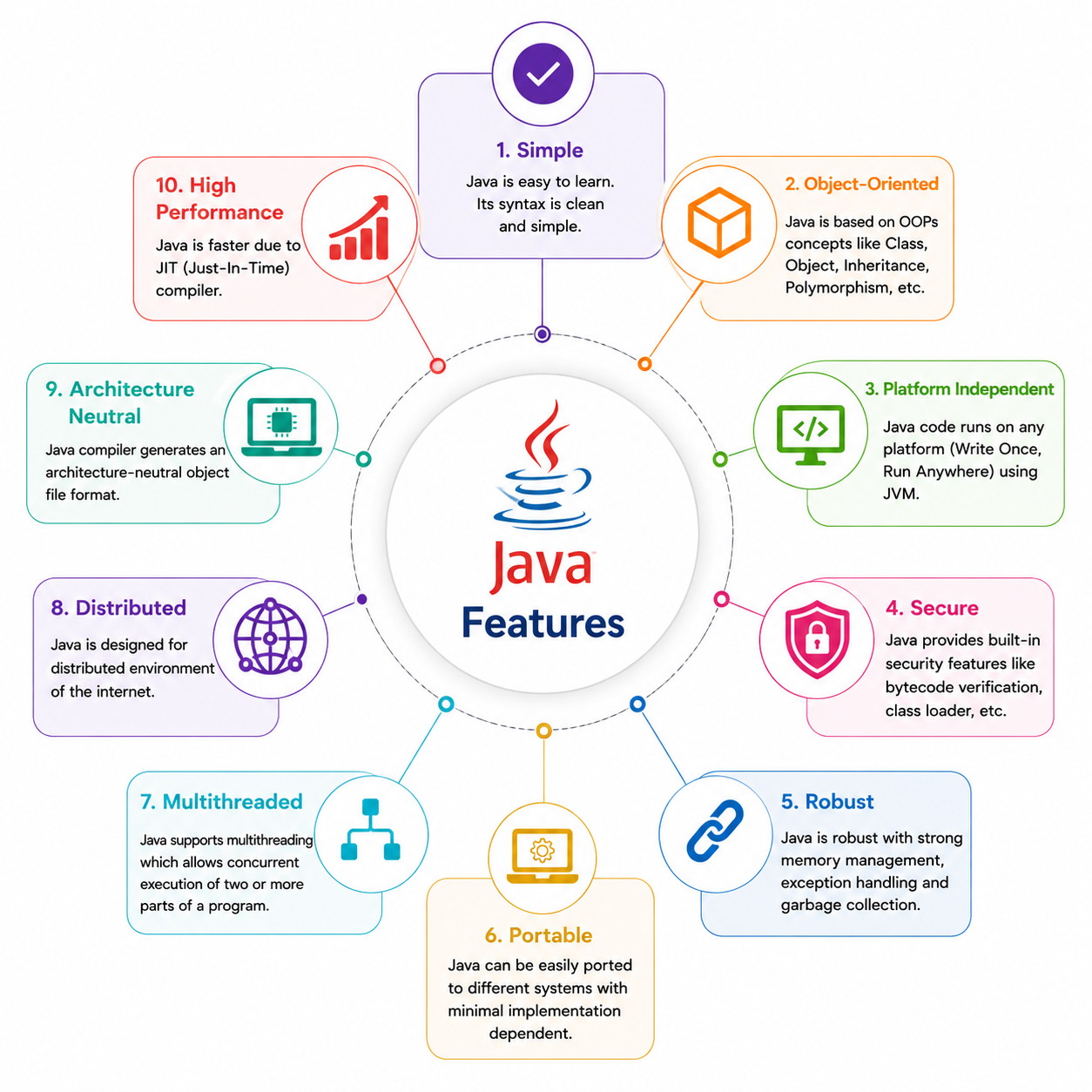
Why is Java So Popular?
Java is one of the most widely used programming languages because it combines simplicity, security, portability, and performance.
- Used in Android development.
- Used in enterprise applications.
- Used in banking and financial systems.
- Used in cloud and backend development.
- Supported by a large developer community.
1. Java is Simple
Java syntax is easy to understand, especially for learners who know C or C++ basics. Java removes complex features like explicit pointers and manual memory management.
2. Java is Object-Oriented
Java supports object-oriented programming concepts such as class, object, inheritance, encapsulation, abstraction, and polymorphism.
3. Java is Platform Independent
Java source code is compiled into bytecode. This bytecode can run on any system that has a JVM. This is why Java follows the principle: Write Once, Run Anywhere.
Java Source Code ➜ Bytecode ➜ JVM ➜ Windows / Linux / macOS
4. Java is Secure
Java improves security by avoiding direct pointer access, running code inside JVM, and verifying bytecode before execution.
- No explicit pointer manipulation.
- Bytecode verification improves safety.
- JVM provides controlled execution environment.
5. Java is Robust
Java is considered robust because it provides strong memory management, exception handling, and compile-time/type checking.
6. Java is Portable
Java programs can be moved from one platform to another without changing the source code, as long as JVM is available on that platform.
7. Java is Multithreaded
Java supports multithreading, which allows multiple tasks to run at the same time. This helps in building responsive and efficient applications.
8. Java Supports Distributed Applications
Java can be used to develop applications that communicate over networks, such as web services, enterprise applications, and backend systems.
9. Java is Architecture Neutral
Java bytecode does not depend on a specific processor architecture. JVM handles execution according to the target machine.
10. Java is High Performance
Java uses Just-In-Time (JIT) compilation to improve execution speed. Although Java is not as fast as C or C++, modern JVM optimizations provide excellent performance for most applications.
Features at a Glance
| Feature | Benefit |
|---|---|
| Simple | Easy to learn |
| Platform Independent | Runs on multiple operating systems |
| Secure | Safer execution environment |
| Multithreaded | Supports concurrent execution |
Why is Java called Platform Independent?
Java source code is compiled into bytecode, and the same bytecode can run on any operating system that has a JVM installed.
- Java is simple and beginner-friendly.
- Java supports object-oriented programming.
- Java is platform independent because of bytecode and JVM.
- Java is secure, robust, portable, and multithreaded.
- These features make Java useful for real-world applications.
Frequently Asked Questions
🧠 Test your understanding with a quick quiz
🚀 Quick Knowledge Check
Topic: Features | Language: Java
Q1. What helps Java achieve platform independence?
Q2. Which Java feature helps manage unused memory automatically?
Q3. What is the meaning of Java being portable?
Q4. Which of the following is a key feature of Java?
Q5. Which feature allows Java to perform multiple tasks at the same time?
Q6. Which OOP concepts are supported by Java?
Q7. Which feature makes Java suitable for secure applications?
Q8. What makes Java robust?
Q9. What does WORA stand for in Java?
Q10. Why is Java considered simple?
🎉 Great job! Continue learning Java step by step.